
A lightweight folding chair designed for portable seating on land and buoyant support in the water.A modular self-watering planter that gives takeout containers a second life
One Chair, Two Environments
The project began with a challenge specific to outdoor recreation: visitors may need lightweight seating while hiking, but the same environment can also involve beaches, tide pools, kayaking, and other water activities.
User interviews showed strong interest in a compact chair that could serve both purposes. Portability was especially important, along with stability, comfort, water resistance, and the ability to recline while floating.
Design Opportunity
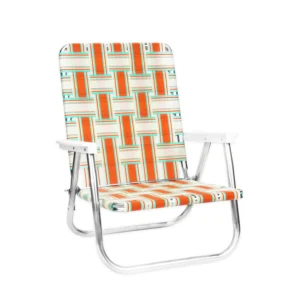
Outdoor seating is useful during long hikes and water-adjacent activities, but carrying separate equipment for land and water adds weight and bulk.
Final Design
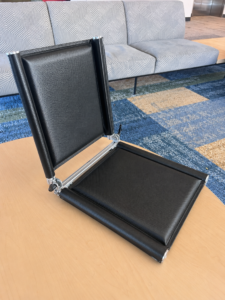
A folding aluminum-frame chair with removable foam pads designed for compact transport, stable seating on land, and secondary use as flotation support.
PROJECT OVERVIEW
Fold 'n Float is a dual-purpose outdoor chair designed for visitors moving between rugged land and water environments.
The team developed a folding aluminum frame with removable buoyant foam cushions, allowing the product to function as portable seating while also providing flotation support. The project combined user research, concept selection, mechanical analysis, and iterative physical prototyping.
DESIGN GOALS
Create an outdoor chair that:
- weighs less than 10 lb (~4.5 kg)
- folds into a compact form
- supports use on both land and water
- resists corrosion and wet environments
- remains stable on uneven terrain
- incorporates buoyant materials
- avoids pinch hazards at folding points
- stays affordable and manufacturable
- allows comfortable upright and reclined positions
INITIAL CONCEPT
The team explored a wide range of approaches for combining portability, seating, and flotation.
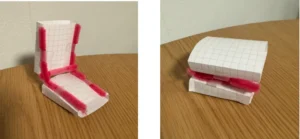
Twenty concepts were compared using criteria derived from user interviews, including weight, profile, land stability, water stability, and comfort. Four leading concepts were then built as low-fidelity prototypes to evaluate their basic form and folding behavior.
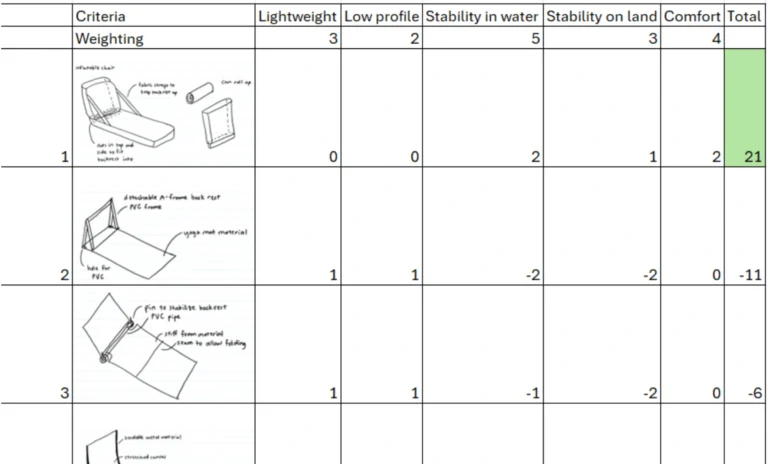
Concept exploration: Twenty approaches were evaluated in a Pugh Matrix against weight, profile, comfort, and stability on both land and water
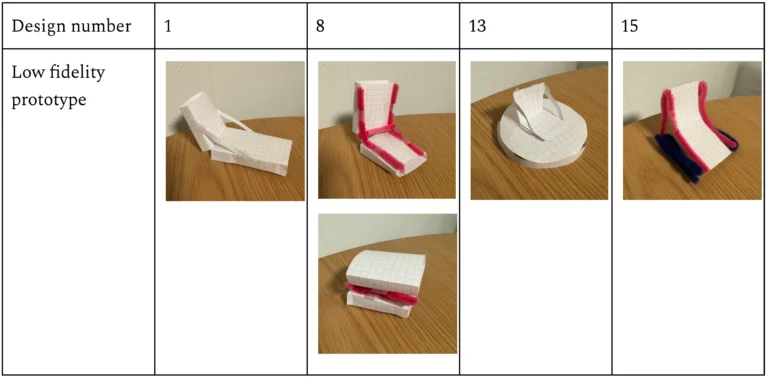
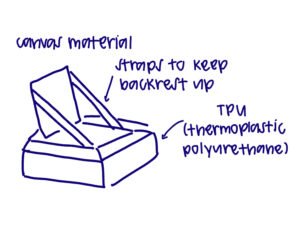
Low-fidelity prototypes: Four leading concepts were physically modeled to compare folding, form, and portability before selecting a direction.
The Problem
Visitors to Channel Islands National Park often move through rugged trails and coastal environments while carrying all of their equipment for the day. Interviews suggested that users were willing to carry a chair only if it remained lightweight, compact, and useful enough to justify the added gear.
The design therefore had to satisfy several competing requirements. Increasing flotation could add volume and weight, while making the frame lighter could reduce rigidity and durability. The chair also needed to remain stable on uneven land, resist wet coastal conditions, and fold without introducing unsafe pinch points.
The challenge was not simply to design a chair that floated. It was to create one product that could transition between portable seating, compact transport, and water use without compromising the core function of each.
Concept Selection & Low Fidelity Prototypes
The team used a weighted Pugh matrix to compare concepts based on the priorities identified through user research: lightweight construction, low profile, stability in water, stability on land, and comfort.
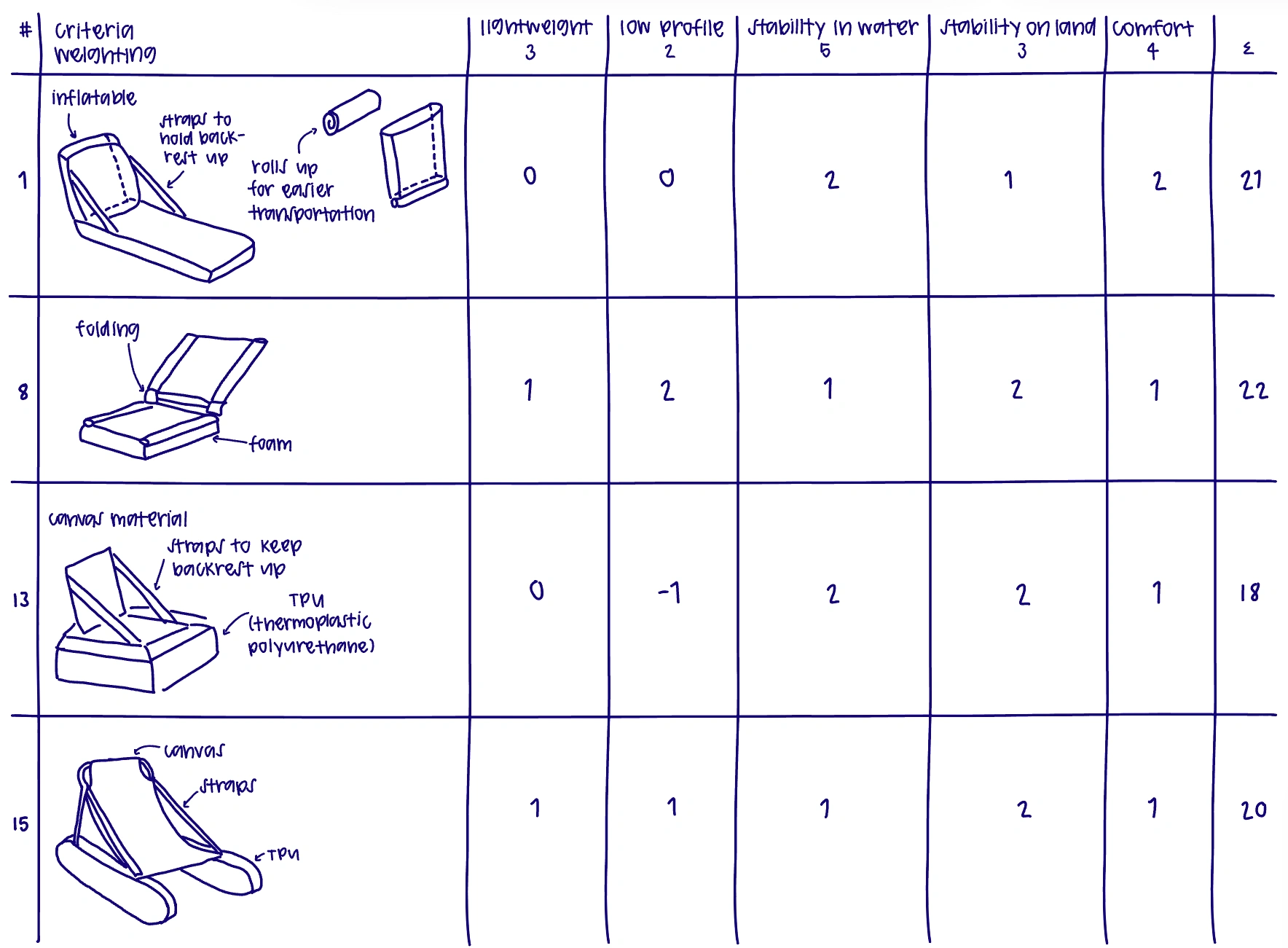
Designs 1, 8, 13, and 15 were selected for low-fidelity prototyping. Among them, Design 8 emerged as the strongest direction because of its simple geometry, low weight, and potential for further improvement. Early calculations suggested that its first form could support only about 19.8 kg in water, but the team chose to continue developing it because the foam-based design could be modified more easily than the alternatives.
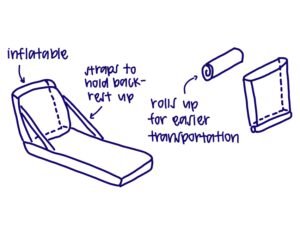
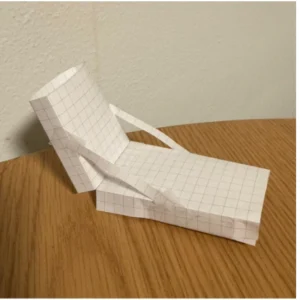
Design 1
Early reclined concept exploring a low-profile seating configuration.
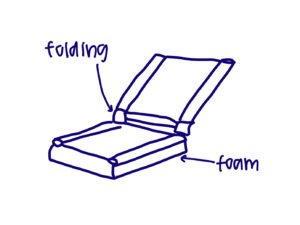
Design 8
Selected concept combining a simple folding frame with lightweight padded seating.
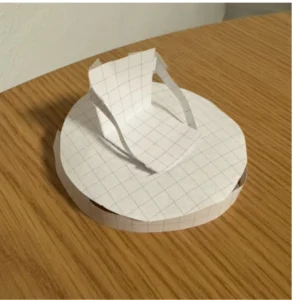
Design 13
Alternative concept emphasizing water stability and buoyant form.
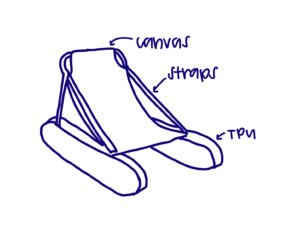
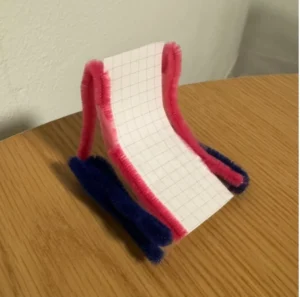
Design 15
Alternative folding chair concept exploring a more enclosed support geometry
Design Iteration
The second iteration focused on correcting the container-fit issue while improving the planter's appearance and character.
Portability
The selected concept used a folding aluminum frame so the chair could collapse into a compact form for hiking and transport.
Locking pivot joints allowed the seat and backrest to fold toward one another, reducing the footprint while still supporting the user when open.
Flotation
Closed-cell foam was incorporated into the seat and backrest to provide buoyancy without absorbing large amounts of water.
The pads were designed to be removable, allowing them to dry, be replaced independently, or be used separately as flotation support in the water.
Adjustability
The chair back was designed around locking pivots capable of holding positions between 0° and 180°.
This allowed the same structure to support a more upright posture on land or a reclined configuration during water use.
Open configuration showing the folding aluminum frame and padded seating surfaces.
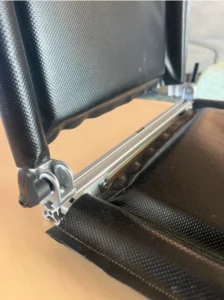
Locking pivot mechanism allowing the frame to fold for transport and hold different seating angles.
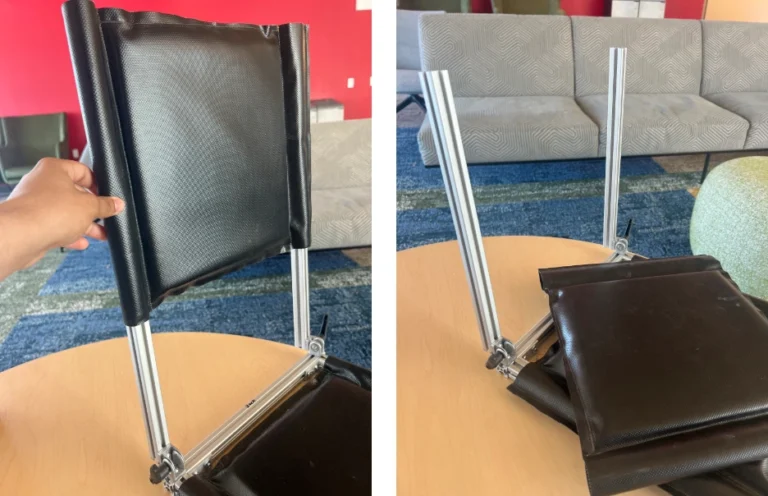
Removable foam cushions designed for easier drying, replacement, and secondary use as flotation support.
Mid-Fidelity Prototype
The first mid-fidelity prototype used cardboard tubes to represent the aluminum frame, paper towels to simulate foam, and an outer cardboard layer to represent the nylon fabric.
This prototype allowed the team to evaluate the overall proportions, hinge behavior, cushion placement, and transition between upright, reclined, and folded configurations before purchasing the final materials.
Testing also raised an important issue: attaching the outer nylon layer using fasteners could create paths for water to reach the foam. The team therefore began considering alternative sealing methods using heat or adhesive.
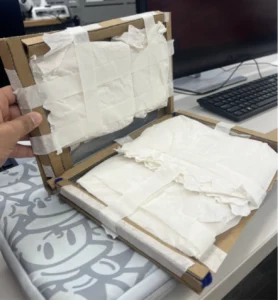
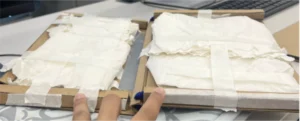
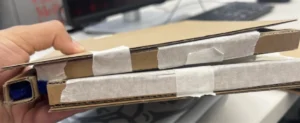
Mid-fidelity prototype used to evaluate folding positions, hinge behavior, cushion placement, and overall form.
Buoyancy Analysis
Because water use was a core part of the concept, the team evaluated whether the foam could provide meaningful flotation.
The final design used two closed-cell foam pads with a combined volume of approximately 0.125 ft³. The analysis predicted a net buoyant force of approximately 7.30 lbf, compared with about 7.54 lbf for a typical pool noodle of similar volume.
This indicated that the removable pads could provide useful flotation support even when separated from the chair.
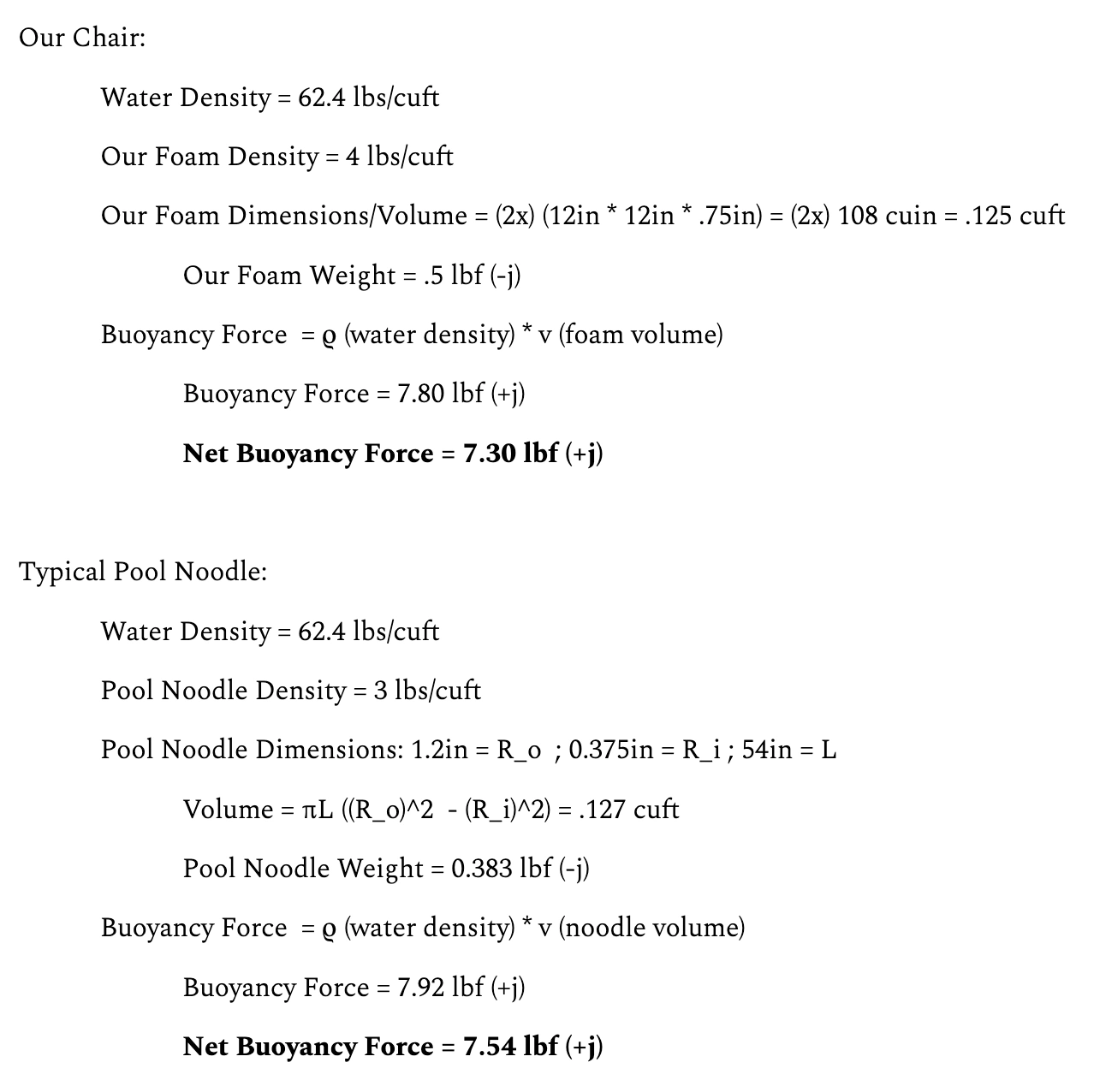
Buoyancy hand calculations comparing the chair’s removable foam pads to a typical pool noodle. The analysis showed that the flotation pads provided nearly equivalent net buoyancy while also serving as removable seat and backrest components.
Structural Analysis
The frame also needed to withstand the user's weight while remaining lightweight enough for transport.
Hand calculations evaluated loading on the chair frame, backrest, hinges, and aluminum rails. In the assumed 45° backrest configuration, calculated bending and torsional stresses remained below the assumed yield strength of the aluminum, producing factors of safety of approximately 6.86 in bending and 7.52 in torsion.
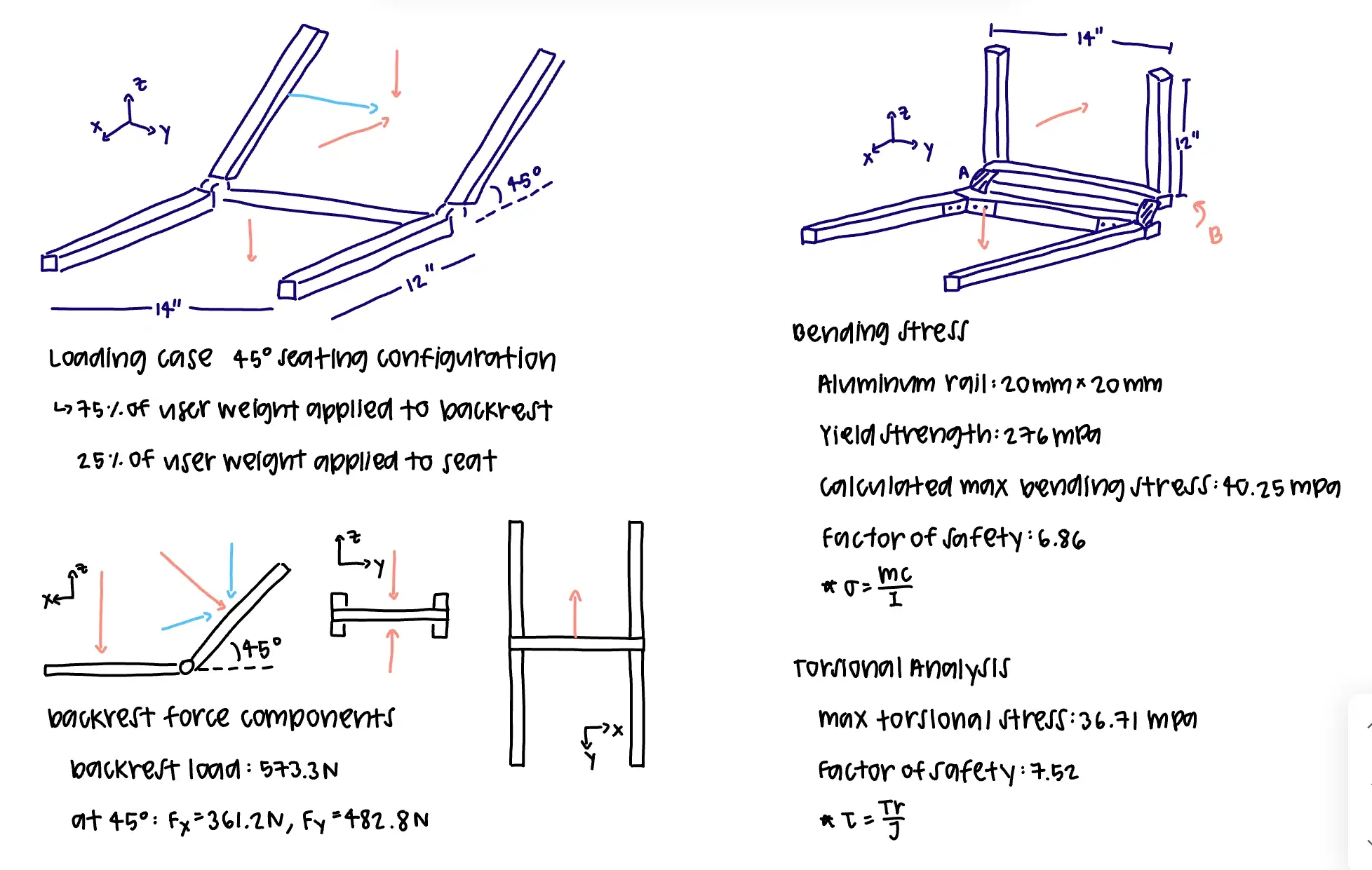
Hand calculations used to evaluate frame reactions, backrest loading, bending stress, and torsion under expected use.
FEA Validation
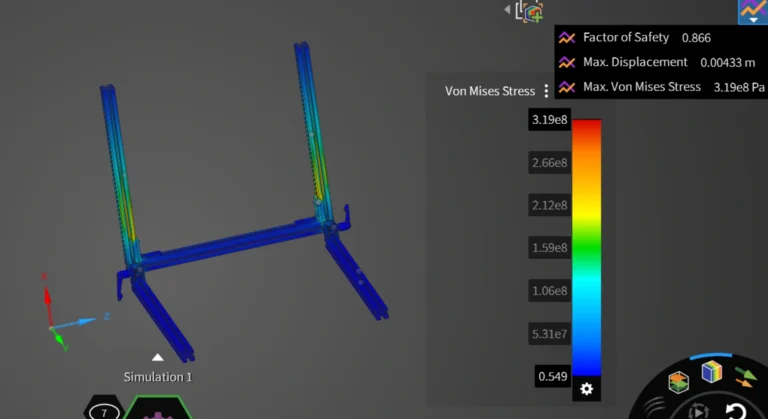
Full-frame FEA highlighting stress concentration near the hinge and bracket connections under conservative boundary conditions.
Finite element analysis was performed on the full aluminum frame without the foam pads.
The simulation approximated the structure using Aluminum 6061-T6 properties and applied the same major user loads considered in the hand calculations: 551 N on the seat, 184 N on the backrest, and a 53.5 N·m inward moment on each vertical bar.
The FEA predicted a significantly lower factor of safety of 0.866, with high stresses concentrated near the brackets. The team recognized that the model constrained the frame more rigidly than the physical chair would behave, but the result still highlighted the bracket region as an important structural concern for future refinement.
Final Prototype
The final prototype combined 2020 aluminum T-slot rails, locking pivots, closed-cell foam, and nylon fabric into a folding chair that reflected the intended product architecture.
The aluminum structure provided a lightweight folding frame, while the removable foam pads created the cushioned seat and backrest and introduced the flotation component.
The design remained a prototype rather than a finished production product, but it demonstrated the key mechanical ideas: folding, adjustable positioning, removable pads, compact transport, and dual land- and water-use.
Results
The project demonstrated a working concept for a portable chair designed around both land and water use.
The final prototype:
- remained under the 10 lb portability target
- folded into a compact configuration
- used corrosion-resistant aluminum framing
- incorporated removable closed-cell foam pads
- supported multiple backrest angles
- demonstrated flotation comparable to a pool noodle using the removable pads
- revealed critical structural areas requiring further refinement through FEA
- translated user feedback into a physical, multi-use outdoor product concept
Future Improvements
- Reinforce the hinge and bracket regions identified as high-stress areas in FEA.
- Refine the frame geometry to improve the structural factor of safety.
- Improve waterproofing around fabric fasteners and seams.
- Develop a sealed or bonded nylon covering to better protect the foam.
- Reduce overall weight through optimized frame sections and material selection.
- Improve the comfort and appearance of the cushions.
- Conduct actual flotation testing with users in controlled water conditions.
- Test stability on uneven ground and moving water.
- Develop an easier method for carrying or attaching the folded chair to a backpack.
- Test the locking pivots through repeated folding cycles.
Key Takeaways
Fold ’n Float reinforced how quickly a multi-purpose product creates competing engineering requirements.
Improving flotation often increased volume, while portability required reducing size and weight. Structural stiffness, comfort, adjustability, cost, waterproofing, and manufacturability all had to be considered alongside those goals.
The project also showed the value of moving between user research, concept evaluation, analytical calculations, simulation, and physical prototypes. Each stage revealed different weaknesses in the design, from user priorities and concept tradeoffs to waterproofing concerns and stress concentrations around the frame connections.
Most importantly, I learned that a successful multi-use product should not simply combine two functions. The two use cases need to influence the same design decisions so that the product remains practical in both environments.